


The Vampire in the Sun
By the end of the 1960s, the vampire was no longer content to wait in the crypt, and had begun to wander into nightclubs and sun bleached strips to wear velvet and eyeliner. He began to desire openly, opting to seduce rather than simply attack. The old Count had loosened his cape, with a younger and more stranger creature taking his place. The creature that had once embodied Victorian nightmares became a vessel for the desires of the new age.

In Vampyros Lesbos, Soledad Miranda does not emerge from a coffin or drift through the corridors of an old decaying castle. Miranda's Countess Nadine Carody lounges underneath an unforgiving sun, with water, modern furniture, bare skin and the strange pulse of psychedelic music haunting her every move. Her Countess doesn't belong to cursed Transylvania, instead, she is found in airports, hotels, bedrooms and swimming pools, moving through the modern world with a narcotic calm, unlike a relic from another century.

The world outside cinema was beginning to change, meaning the vampire had to change with it. The sexual revolution meant that it was only natural that the vampire, a creature whose existence depended on crossing boundaries, would flourish in a time of youth culture bending the old boundaries between the respectable and the forbidden. Blood and sex had always flowed alongside one another in the myth of the vampire, but by the turn of the decade, there was less need to hide that aspect. The bite finally began to represent the sensual kiss it had always been.
Miranda herself seems inseparable from this atmosphere of modern sexual ideals clashing with ancient stories. With enourmous dark eyes framed by heavy lashes, long black hair, and an expression that shifts constantly between innocence, boredom and invitation, her beauty was not the icy aristocratic beauty traditionally associated with the vampire. She was warmer and stranger, unmistakably late 60s with a languid and sensual and somewhat bohemian aura that was difficult to pin down.

Half a century later, Soledad Miranda survives in fragments of moving light, a glance held slightly too long, black hair against bare shoulders, a cigarette, and a pair of eyes looking directly into the lens of the camera. To those devotees of European cult cinema, specifically the films of Jesús Franco, Soledad Miranda remains an icon. However, moving past that strange corner of film history, her name has faded far more than her image. She occupies a peculiar position of an actress who is both forgotten and remembered, being endlessly reproduced in photographs and film stills while the woman inside those images becomes more and more difficult to see.
Miranda had already spent years working in Spanish cinema, appearing across genres before her collaboration with Franco transformed her into something enigmatic and darker. Appearing under the name 'Susann Korda,' at only 27 years of age, she was killed in a car accident. Several of the films that would create her cult following and reputation reached audiences after her death.

The accident, unfortunately, hangs over any modern viewing of Miranda's work, allowing it to consume her story. Cinema has always had a fetish for beautiful people who die young, with death tidying an untidy life into mythology. Unfinished careers becomes 'lost potential,' photographs inevitably become relics, and youth becomes permanent. In Miranda's case, the effect is uncanny, with her most remembered role being the vampire. She played an immortal woman shortly before becoming permanently fixed on rolls of film at 27.
Yet Vampyros Lesbos deserves to be remembered for more than its lead actress' fate. Miranda's Countess Nadine showcases a genuine transformation in the cinematic vampire. The unmistakable gothic vocabulary had been stripped clean, with crosses, castles and moonlit graveyards giving way to modern rooms and brilliant daylight. Darkness itself started becoming unnecessary, with Countess Nadine existing beneath the sun, her desire out in the open.

The vampire has always been an unusally flexible vessel for forbidden sexuality, but there is something significant about the fact that this new vampire is a woman who desires other women. From the charged intimacy of Sheridan Le Fanu's Carmilla, to the erotic menace surrounding Dracula's nocturnal visits, the vampire has always been a synonym for forbidden sex. But the female vampires of the late 60s and early 70s brought those implications closer to the surface. Ingrid Pitt's Carmilla in The Vampire Lovers belonged to this same moment, although she remained surrounded by Hammer's Gothic trappings. Miranda's Nadine feels different, like she has left the nineteenth century behind completely.
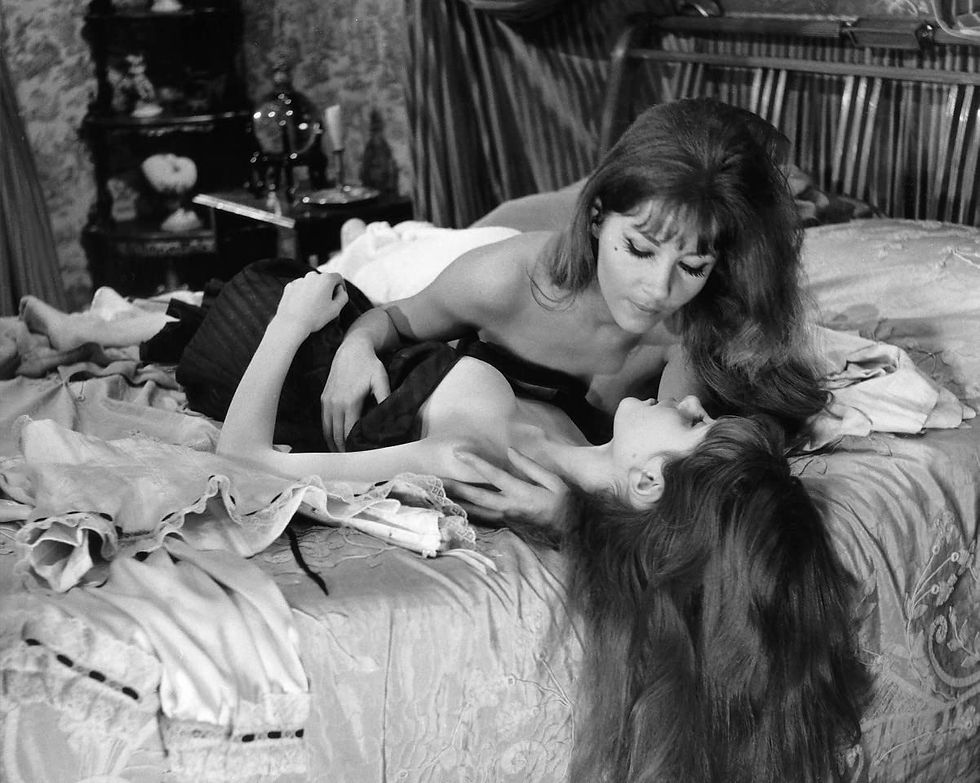
Liberation and exploitation sit uncomforably side by side in these films. Vampyros Lesbos was directed by a man and marketed partly through the spectacle of lesbian desire and women's bodies. It is easy for one to look back on the film's sexual openness and mistake the visibility for emancipation. Yet it is also reductive to dismiss Miranda's presence as nothing more than a carefully constructed object for the camera. Countess Nadine knows that people are watching her, but she appears to control that gaze by refusing to give the audience what they expect.
Her power is her stillness. Where Christopher Lee's Dracula could erupt into sudden animal violence, Miranda often seems to draw people toward her by doing nothing. She watches, she waits, and she allows the the other person to close the distance. Her vampirism is less an invasion, but more of a gravitational pull. There is no need to hammer at the bedroom window when the victim is already dreaming of entering yours.
This makes her a fitting vampire for the beginning of the 70s. The monster was no longer an embodiment of external evil threatening the stability of ordinary life. The vampire represented desires already present within the 'innocent' characters around it. The horror lay not only in being seduced, but discovering that the seduction had been wanted. Miranda's Nadine does not manufacutre desire from nothing but reveals what is already there.

Soledad Miranda is not trapped in the period the same way as the cobwebbed castles and aristocratic Count's that preceded her. Put her beside the fashion photography, album covers and underground cinema of the era and she is completely at home. Her vampirism belongs to a world of psychedelic music, sexual experimentation, and beautiful young people searching for experiences.
The tragedy is that Miranda herself would never see what became of the image she helped create. She would never grow old enough to look back upon Countess Nadine as an early role, never have the chance to reject the cult surrounding it or embrace it, never decide whether Soledad Miranda would remain the dark eyed vampire preserved on posters or become something different. Cinema made that decision for her. It kept the face and lost the future.
This is the strangest form of immortality the vampire can offer. Not eternal life, but eternal youth. The preservation of a person at a single moment in time while the world around them continues ageing. Soledad Miranda remains somewhere in 1970, walking through sunlight without a cape, a coffin or any apparent fear of the day. The old Count had spent generations retreating from dawn. Miranda's vampire stepped into it.


Comments